
Sore, Tired or Overloaded? How to Know Which Massage Your Body Needs

Not every tired, aching body needs the same massage.
The treatment that feels appropriate after a hard Saturday run may be completely different from what your body needs after several weeks of work pressure, interrupted sleep, exercise, driving, family commitments and too little recovery.
The useful question is not:
“How deep should my massage be?”
It is:
“What is my body recovering from?”
Once you can distinguish muscle soreness, physical fatigue and accumulated overload, choosing the right massage becomes much easier.

Don’t choose your massage according to how hard you think it should be. Choose it according to what your body is recovering from.
Soreness — “Certain muscles hurt.”
You know which muscles are complaining and usually know what caused it: yesterday’s run, squats, hills, padel match or unfamiliar workout. Book a Targeted Sports or Fusion Massage using comfortable, moderate recovery work and more focused techniques where useful.
Fatigue — “Nothing particularly hurts. My body just feels spent.”
Your legs feel heavy, the stairs feel harder than usual and you have less physical energy, but there is no obvious injury or single painful muscle. Broader light-to-moderate whole-body massage designed to help the body recover without adding another demanding experience.
Physical overload — “I don't seem to recover properly anymore.”
It is no longer about yesterday’s workout. Work, exercise, poor sleep, driving, family responsibilities and a full diary have accumulated faster than you are recovering from them. A slower, restorative whole-body experience such as Prestige or gentler Fusion, with enough time for the body to genuinely settle.
Soreness = local tissue response Fatigue = reduced physical capacity Physical overload = recovery is no longer keeping up with total demand
What Kind of Pain Are You Actually Experiencing?
People often use the words sore, tight, stiff, tired, heavy, exhausted and painful as though they mean the same thing.
They do not.
You can have sore muscles without being generally fatigued. You can be physically tired without having any particular pain. And you can feel tight, heavy and exhausted for weeks because the total demands on your body have exceeded the recovery available between them.
These experiences can overlap, but separating them gives you a much better starting point for choosing massage.
Think of it this way:
Soreness asks: “Which muscles need recovery?”
Fatigue asks: “How much physical energy do I have available?”
Physical overload asks: “When did I last feel properly recovered?”
Those are very different questions—and they lead to different massage choices.
Sore Muscles After Exercise: “I Can Tell You Exactly What Hurts”
Saturday morning started with a longer-than-usual run around Midstream. Or perhaps it was squats at the gym, hills on the bike, a hard padel session or a workout you have not done for several weeks.
Sunday morning arrives and the legs are stiff.
By Monday, walking downstairs provides a remarkably accurate reminder of exactly which muscles you trained. That is the classic territory of post-exercise muscle soreness.
What Muscle Soreness Feels Like
You can normally identify the affected area:
quads feel sore when getting out of a chair;
calves are tender after running;
glutes complain after hills or squats;
shoulders ache after unfamiliar upper-body work;
muscles feel stiff when you first get out of bed;
stairs make yesterday’s training particularly memorable;
pressure over the muscles feels tender.
Delayed-onset muscle soreness, or DOMS, commonly follows unfamiliar or sufficiently strenuous exercise, particularly movements involving substantial eccentric muscle loading. Symptoms generally develop after the exercise and are commonly most noticeable around 24–72 hours later.
This is why you may feel reasonably good when leaving the gym and considerably less impressed with your decisions the following morning.
Why Soreness Changes the Massage
A sore muscle does not automatically need the deepest pressure available. The tissues have already received a substantial physical stimulus from the exercise itself. The better recovery approach is usually comfortable, purposeful work through the muscles that were actually loaded.
That may include:
broad rhythmic massage;
moderate pressure;
comfortable mobilisation;
work through the surrounding movement chain;
more focused pressure where the tissues respond well to it.
Massage has good evidence for reducing perceived DOMS after demanding exercise. Meta-analyses have found reductions in post-exercise soreness, with additional evidence for small improvements in flexibility. The practical value is that sore legs may feel easier to move, walking becomes more comfortable and the next few recovery days feel less dominated by the previous workout.
Which Massage Should You Choose for Sore Muscles?
Sports Massage works well when you know exactly what activity produced the soreness and want focused recovery through the muscles involved.
Fusion Massage works well when the soreness is part of a wider pattern—for example sore legs combined with tight hips, glutes and lower back. A Fusion session can move between broad Lomi Lomi flow, focused muscular work, heat, myofascial techniques and other appropriate methods according to how the body responds.
Book this when:
“I exercised hard, I know why I’m sore, and specific muscles need recovery.”
Physical Fatigue: “I'm Not Injured. My Body Just Feels Empty.”
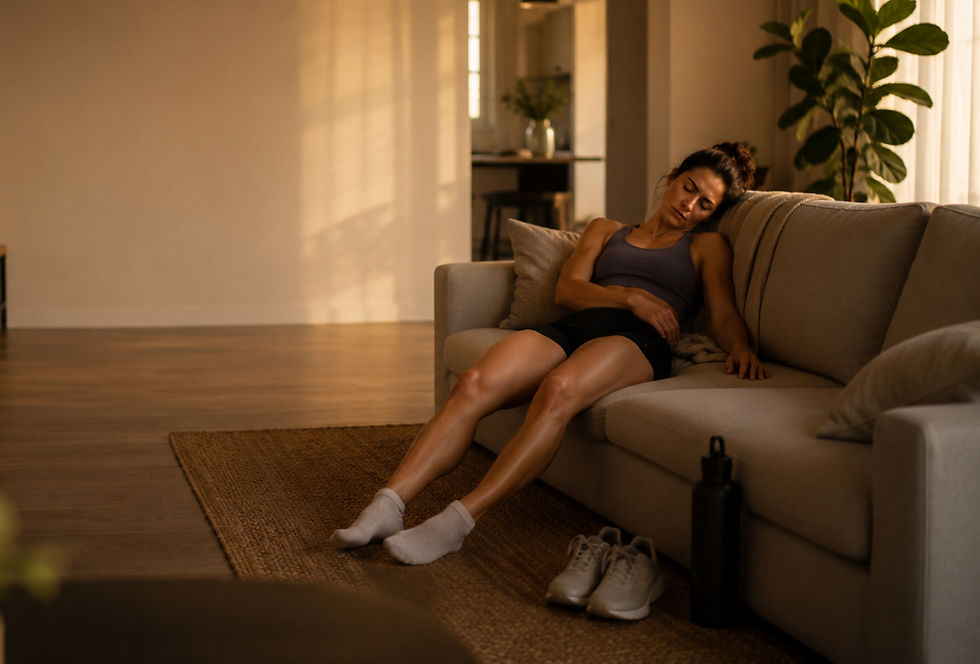
Fatigue feels different. Nothing is particularly injured. You may not even describe yourself as sore.
The body simply feels as though somebody forgot to charge it overnight. You exercised over the weekend, spent Sunday on your feet, returned to work on Monday, drove between appointments, dealt with ordinary life and by Tuesday the stairs suddenly seem much longer than they were last week. Your legs feel heavy.
Movement requires more effort.
The body is capable of doing things, but it does not feel enthusiastic about doing them.
What Physical Fatigue Feels Like
You may notice:
heavy legs;
reduced physical energy;
normal exercise feels unusually difficult;
the muscles feel flat rather than painful;
less strength or power;
stairs require more effort;
you want to sit down more often;
the body does not feel ready for another demanding session.
This distinction matters because fatigue does not require pain.
The body can be tired without anything being wrong with a particular muscle. Sport and recovery research recognises fatigue and recovery as multidimensional experiences. Physical load, psychological demands and other life stresses all contribute to the balance between what a person expends and what they restore.
Why Fatigue Needs a Different Massage
When specific muscles are sore, focused treatment makes sense. When the whole body is tired, constantly searching for a painful knot may miss the point.
The person may benefit more from broad, comfortable whole-body work. The massage can become less about fixing one area and more about allowing the entire body to receive:
rhythmic movement;
light-to-moderate pressure;
broad leg and back work;
comfortable joint movement;
time to stop physically working;
a period of genuine passive recovery.
Research comparing post-exercise recovery techniques has found massage particularly useful for reducing perceived soreness and fatigue. For the tired client, that subjective improvement matters. Feeling physically recovered influences whether tomorrow’s walk, gym session or ordinary working day feels manageable.
Which Massage Should You Choose for Physical Fatigue?
A relaxing whole-body Fusion Massage is often an excellent choice. The therapist can keep the pressure comfortable, use broader rhythmic techniques and work through the whole body rather than making the session another physically demanding event.
Lomi Lomi flow can also become particularly valuable here because its continuous rhythm allows tired areas to be addressed without repeatedly turning the client’s attention toward individual problems.
This is also an important reason to normalise booking a massage simply because you are tired.
You do not need an injury.
You do not need a diagnosis.
You do not need to arrive with a complicated list of knots that require fixing.
Sometimes the body simply needs recovery.
Book this when:
“Nothing is particularly wrong. I’m simply physically tired and need to recover.”
Physical Overload: “Why Am I Still Tired When I've Already Rested?”
Physical overload is different again. One hard workout is no longer the problem.
The problem here is the accumulation of multiple loads.
Work pressure.
Exercise.
Driving.
Poor sleep.
Family responsibilities.
Weekend commitments.
Sitting for hours.
Trying to squeeze another workout into a body that did not fully recover from the previous three days.
Individually, none of these demands may seem excessive. Together, they can become significant. Recovery research emphasises that the body responds not only to training load but also to other life demands and psychological stress. Maintaining an appropriate relationship between total load and recovery is important for ongoing physical function and wellbeing.
What Physical Overload Feels Like
You may notice:
persistent physical tiredness;
recurring neck and shoulder tension;
legs that feel heavy even without a hard workout;
reduced motivation to exercise;
poorer-than-normal performance;
stiffness that returns very quickly;
sleep that does not seem restorative;
increasingly long recovery after activity;
feeling physically switched on even though you are exhausted;
several parts of the body complaining at once.
The key clue is often duration.
With ordinary soreness, you can usually identify what caused it. With fatigue, a quieter day may make a noticeable difference. With physical overload, you start wondering:
“Why don't I seem to bounce back anymore?”
Physical Overload Is Not Automatically Over-training Syndrome
Over-training syndrome is a much more specific and complex condition used primarily in sport and involves prolonged maladaptation and sustained performance problems. It is not a label that should be casually applied to every busy person who feels exhausted.
For everyday clients, physical overload is more useful language because it describes the experience of total demands repeatedly exceeding the amount of recovery available between them. And those demands do not have to come from sport.
Your nervous system and muscles do not maintain separate spreadsheets marked:
Gym
Work
Driving
Children
Bad night's sleep
Housework
The body receives the combined load.
Why an Overloaded Body Needs a Different Massage
This is where the objective changes most significantly.
The answer is no longer:
“Let's find every tight muscle and work harder on it.”
The better question becomes:
“How do we give an already overloaded body a genuinely restorative experience?”
The treatment can slow down. Pressure can become gentle to moderate. The whole body receives attention rather than treating every area as a separate fault. The client has enough time to stop rushing, settle into the treatment and allow physical effort to decrease.
The massage may emphasise:
flowing whole-body work;
mindful meditation
slower rhythm;
comfortable pressure;
broad muscular relaxation;
breathing;
warmth;
passive recovery;
longer uninterrupted treatment time.
This is often where Prestige Massage becomes particularly valuable.
The additional time means the body does not have to relax on command within the first ten minutes. Massage can be combined with breathing, gentle movement, meditation and substantial quiet time according to what the client needs.
Book this when:
“It's no longer one sore muscle. I feel as though I haven't properly recovered for weeks.”
Wrap Up
The massage your body needs after a hard run is not necessarily the massage it needs after three demanding weeks.
A generally tired body may benefit more from broad, comfortable whole-body massage.
Accumulated physical overload calls for a slower restorative approach with enough time for the whole person to settle.
That distinction matters because good massage is not about applying the maximum pressure the body can tolerate. It is about choosing the experience that best matches what the body is recovering from.
You do not need to work out the answer alone.
Not sure whether you're sore, fatigued or simply overloaded? Tell Kahe Hands what you're feeling and what your week has looked like, and we'll help you choose the massage, pressure and duration that match the recovery your body needs.
Frequently Asked Questions
What massage should I get for sore muscles?
When specific muscles are sore after exercise or unusual activity, Sports Massage or targeted Fusion Massage usually provides the clearest recovery direction. Moderate, comfortable work can be focused on the muscles that were loaded and their supporting movement chain.
Is Sports Massage good for sore muscles?
Yes. Sports Massage is particularly useful when soreness has a clear activity-related cause, such as running, cycling, gym work or recreational sport. Research supports massage for reducing perceived delayed-onset muscle soreness after strenuous exercise.
Should I get Deep Tissue Massage when my muscles are sore?
The massage should be selected according to why the muscles are sore and how they respond to pressure. Fresh post-exercise soreness often suits moderate recovery work better than automatically choosing maximum depth. Persistent muscular restriction at other times may make focused Deep Tissue Massage appropriate.
What massage is best when my whole body feels tired?
When there is no specific injury and the main experience is physical fatigue, broader light-to-moderate whole-body massage can provide a more appropriate recovery experience than highly focused deep work.
Can I book a massage simply because I'm tired?
Yes. Massage does not require an injury to be worthwhile. Physical fatigue, heavy legs, general muscular tension and the need for passive recovery are all valid reasons to book a massage.
What massage is best for stress and exhaustion?
When stress, tension, poor sleep and physical fatigue have accumulated over time, a restorative whole-body treatment such as Prestige or gentler Fusion Massage can provide the time and broad approach needed for deeper recovery.
How do I know whether I'm sore or fatigued?
Soreness tends to be local: you can identify which muscles hurt. Fatigue is broader: the body feels physically depleted and ordinary activity requires more effort even when no particular muscle is especially painful.
What is physical overload?
Physical overload is useful everyday language for a situation in which exercise, work, poor sleep, driving, family responsibilities and other demands are accumulating faster than the body is recovering from them. It is not the same as a diagnosis of overtraining syndrome.
Is deeper massage better for recovery?
The most useful pressure is the pressure that matches the recovery state. Sore muscles may suit moderate targeted work, general fatigue may suit broad comfortable massage, and accumulated overload may suit a slower restorative treatment.
Where can I get a recovery massage near Midstream?
Kahe Hands Wellness Studio in Centurion provides Sports, Fusion, Lomi Lomi and Prestige Massage, allowing the treatment style, pressure and duration to be matched to whether you are experiencing specific soreness, general fatigue or accumulated physical overload.


Comments