
Why Tight Hips Affect More Than the Hips

A practical guide for busy professionals who feel the effects of hip tightness in far more places than they expected.
Tight hips rarely stay politely local. They often change how the whole body moves.
Hip tightness often shows up somewhere else first — in the lower back, knees, hamstrings, stride, or general heaviness of movement.
Sitting, stress, travel, and repetitive routines quietly train the hips to become stiffer and less responsive over time.
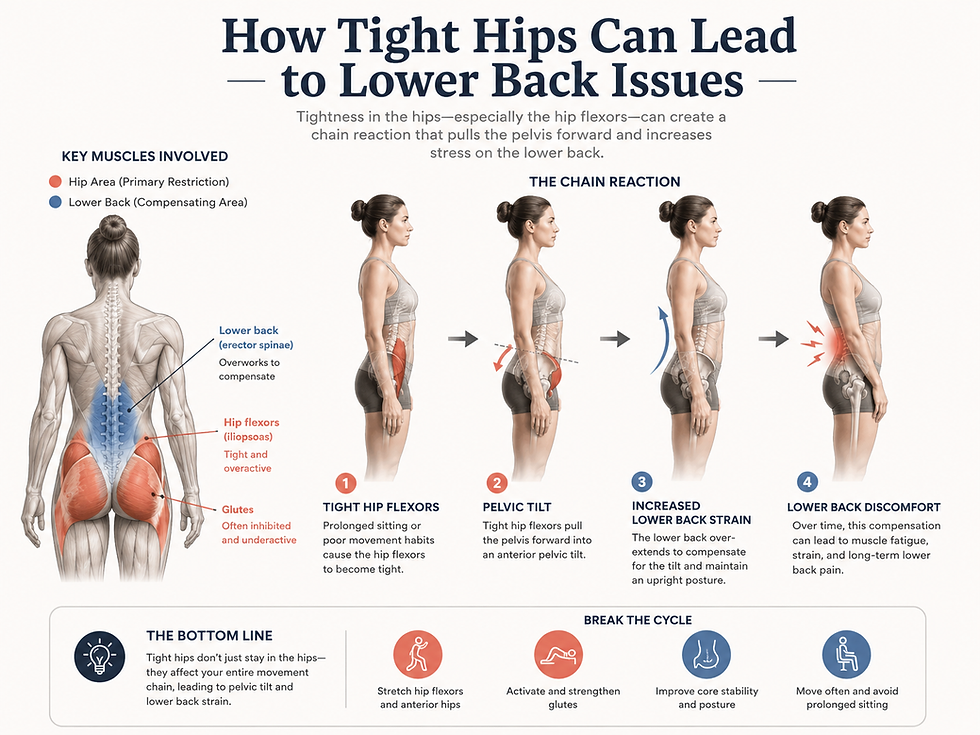
When the hips lose movement, other areas compensate. That usually means extra work for the lower back, knees, and lower legs.
This is why random stretching often disappoints. The body usually needs better movement patterns, better breath, and better lower-body coordination.
Guided movement therapy gives the body a calmer way back by restoring balance, awareness, and more usable mobility from home.
The Hip Mobility session is designed for exactly this problem. It helps reduce tension, improve movement quality, and make the body feel less held.
Why the Hips Matter So Much
The hips sit at the center of a great deal of daily movement.
They influence walking, bending, standing, climbing stairs, getting up from a chair, and how force travels through the lower body. When they move well, the rest of the body usually has more options. When they do not, those options narrow quickly.
That is the real issue.
A tight hip is not only a tight hip. It is often a reduction in choice. The body starts finding workarounds. It leans on the lower back more heavily. The knees take more strain. The calves and feet start carrying more load. Movement still happens, but the quality changes.
And once quality changes, effort increases.
Why Busy People End Up With Tight Hips
For most executives and desk-based professionals, tight hips are not mysterious.
They are trained.
Too much sitting keeps the hips in a flexed position for hours at a time. Too little movement variety means the body repeats the same limited patterns all week. Travel compresses the body further. Stress encourages bracing. Even exercise, when squeezed into a busy schedule, often becomes one more repetitive demand rather than a true reset.
That combination creates a very familiar outcome:
stiff hips
heavy glutes
tight hip flexors
lower back tension
reduced stride
a body that feels older than it should
The hips are not “bad.”
They are responding to the life you are asking them to carry.
Why the Lower Back Often Takes the Hit
One of the most common side effects of tight hips is a lower back that feels busy all the time.
That happens because the lower back often starts doing work the hips should be sharing. If the hips are not moving well into extension, rotation, or comfortable flexion, the body still needs to bend, stand, walk, and function somehow. So the lower back compensates.
This is one reason people say things like:
“My back is always tight.”
“I feel stiff when I stand up.”
“Stretching my back helps, but only for a little while.”
Sometimes the lower back is not the starting point.
Sometimes it is the complaint department.
Why the Knees and Hamstrings Get Drawn In
Tight hips also change what happens below them.
If the hips do not move freely, the knees often lose ideal support. The hamstrings may stay permanently loaded. The glutes may stop contributing as well as they should. Even squatting, stair climbing, and walking can feel less smooth.
This often shows up as:
knees that feel unsupported
hamstrings that never quite let go
one-sided tightness
awkward squats
less confidence in balance and single-leg movement
That is why a person may spend weeks trying to stretch the hamstrings when the deeper issue is that the hips are not participating properly.
The body is always sharing work.
If one area stops contributing well, another area starts complaining.
Why Movement Starts Feeling Heavier
This is the part many professionals notice first, even if they do not have the language for it.
Movement begins to feel heavier than it should.
You can still walk. Still train. Still get through the day. But the body does not feel free. It feels effortful. Less spring. Less ease. Less support through the lower body.
That matters because heaviness is often an early signal.
Not necessarily of injury.
But of inefficiency.
And inefficiency always costs something:
energy
confidence
comfort
recovery
resilience
The body is still working. It is just working too hard for results that should feel simpler.
Why Stretching Alone Usually Misses the Point
This is where many people lose patience.
They stretch the hips. They do a few openers. They try to be disciplined. But the tightness keeps returning.
That usually happens because the problem is not only length.
It is pattern.
If the body still sits all day, braces under stress, moves with poor control, and never learns a better rhythm, then the hips often return to the same old tension. Stretching can create a brief window of relief, but it does not automatically reorganize how the body moves.
That is why guided movement matters.
The body often needs:
better breathing
controlled mobility
improved lower-body coordination
restored awareness
a safer, calmer way of moving through range
That is a much better standard than simply “stretch harder.”
Why Guided Movement Therapy Works Better
For busy professionals, the issue is not just knowing that mobility matters.
It is having a realistic way to address it.
That is what guided movement therapy solves.
It gives you a structured, calm, repeatable way to:
improve hip mobility
reduce tension
restore lower-body support
move with more confidence
stop guessing what to do next
And because it is done from home, it becomes much easier to use consistently.
That matters more than most people think.
A perfect routine done once is less useful than a smart routine you can actually return to.
How the Hip Mobility Session Helps
The Hip Mobility movement session is designed to help the body move out of this exact pattern.
It is not built as an intense workout.
It is built as a reset.
Using breath, controlled movement, and restorative support, it helps:
reduce hip tightness
improve lower-body coordination
ease strain through the back, knees, and legs
create better movement quality
help the body feel lighter and less restricted
For the person whose hips are quietly affecting everything else, that is often the right starting point.
Not because it does everything.
Because it addresses the pattern more intelligently.
A Practical Place to Begin
If this sounds familiar, begin with a better question.
Not:“How do I force my hips open?”
But:“How do I help my body move with more balance again?”
A smarter starting point looks like this:
notice where sitting is shaping your body
stop treating the lower back or hamstrings as isolated problems
use guided movement rather than random effort
choose restoration before intensity
build consistency before complexity
That is the kind of approach the body usually responds to best.
The More Useful View
Tight hips are not only about mobility.
They are about consequence.
They affect how the whole lower body organizes itself. They influence effort, alignment, confidence, and comfort. And if left alone, they often make other areas work harder than they should.
That is why this deserves attention.
Not because the hips are dramatic.
Because they are central.
What to Take With You
If your lower back, knees, hamstrings, or stride have been feeling “off,” it may be time to stop chasing the symptom and start looking at the hips more seriously.
The body usually does better when the right area gets the right support.
Message +27 71 261 7436 on WhatsApp with “Sign Me Up”.
Related articles


Comments